CAPTURE THE MARKET · TEAM BUSINESS GAME

Test your strategyon a live market

Starting a business or already running one — two hours at the table show you what otherwise takes months of business school and years of work.

Upcoming games
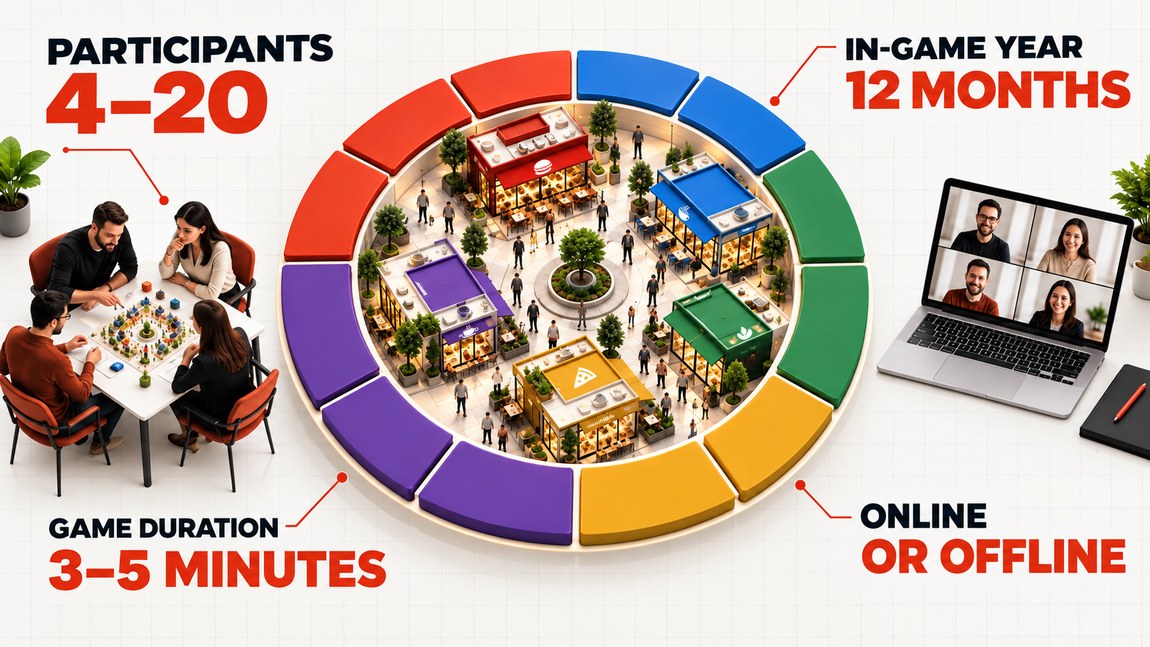
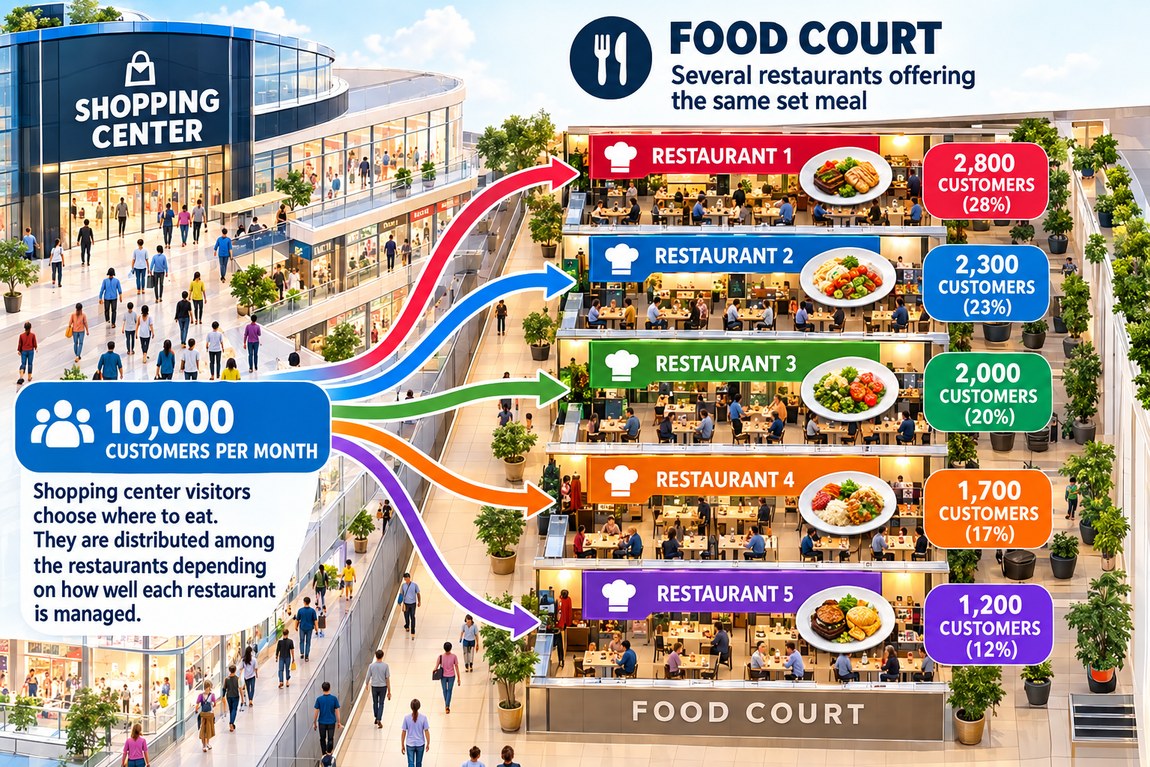
Game diagram: the flow of shopping mall customers is distributed among competing food court restaurants
WHAT IT IS

How the business game works

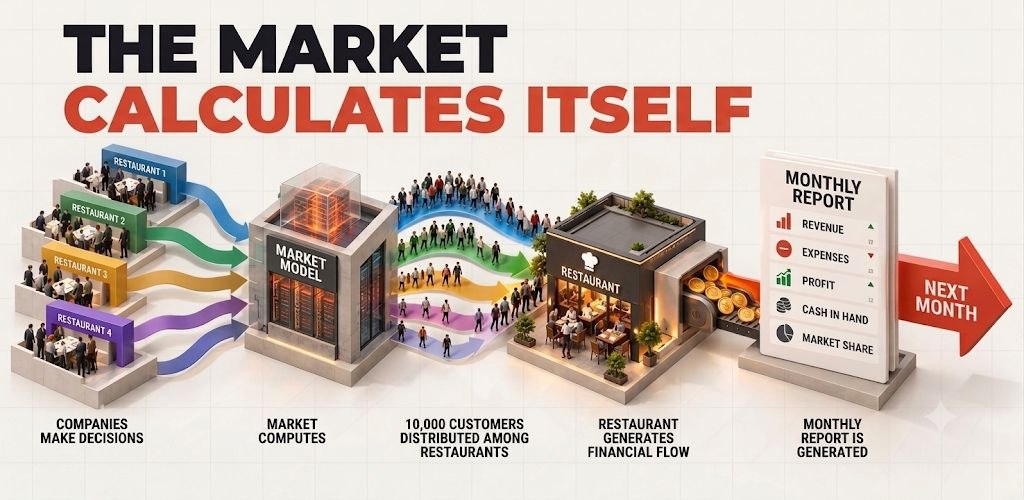
Several companies play on one market. The customers are shared, and every player has to pull them their way. Each turn is a game month: you set the price, invest in quality, choose advertising channels, add tables, hire people, take loans. Whether a customer walks in or goes to a competitor depends on what you decided. Exactly like a live market — and who pulled whom is worked out by the model, not by the host.

Every month there is a financial report. You see the result of your own moves and, more importantly, of your competitors': revenue, costs, profit, the going price on the market, cash in the register and market share. Then the debrief, a new strategy and the next month.

The winner is whoever ends up with the most cash in the register.

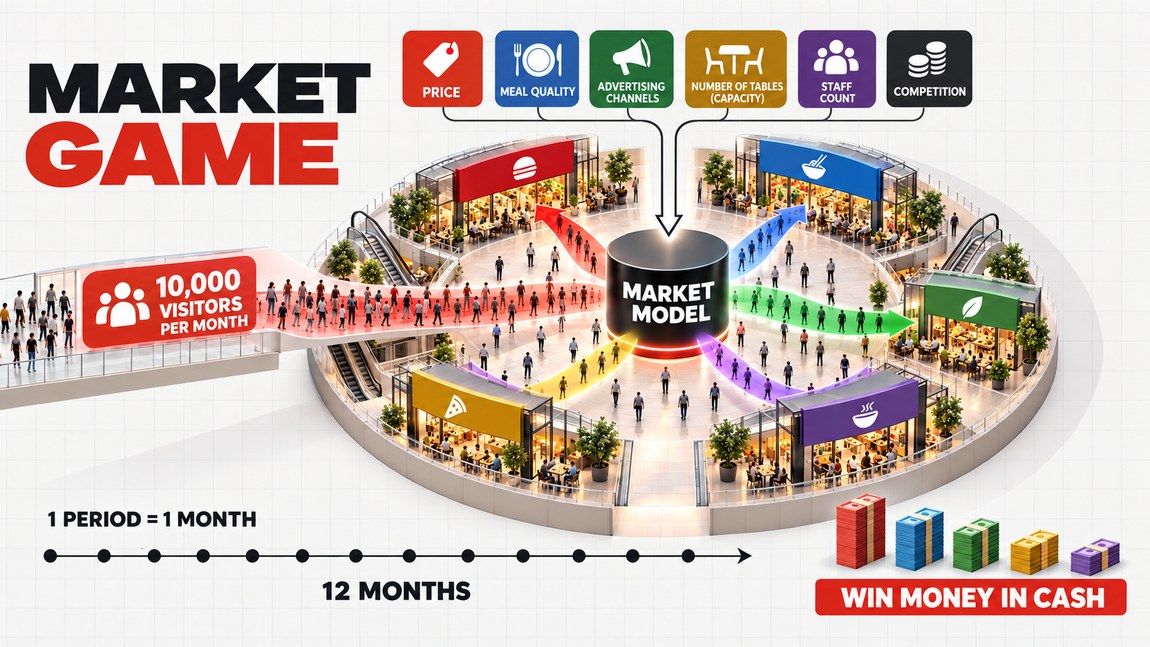
One market for everyone: a flow of 10,000 customers passes through the market model and is distributed among competing restaurants. One turn equals one month, a game year is twelve months
THE MARKET MODEL

See how it works

Here is the whole game on one screen. Imagine the red restaurant is you. Drop the price and the flow comes your way, but every bill gets thinner. Raise quality and people come back, so you can hold a higher price. Pour money into advertising and awareness grows, but the cash leaves the register right now.

Move the levers — price, quality, advertising, seating — and watch customers flow between the five restaurants and what is left for you in the end: revenue, profit, market share. Nobody hands out grades. Only the market counts. A live game works the same way — just twelve months in a row, with players like you at the next table. The numbers here are simplified, but the logic is exactly the same.

Try it right now. Below is a demo calculator running the same model: move the levers and see what happens. All five restaurants start with the same $50,000 in the register — after that, only the decisions make the difference.

Your restaurant · P1

The red one on the chart is you

$9.50
6 / 10
$3,750
120

Cash in the register · month 1 of 12

$50,000

Where the 10,000 customers go

Customers go where it is cheaper and tastier

This shows a single year, as in League 12. The competitors here stand still; in a live game they move at the same time as you, and that changes everything.

WHAT HAPPENS AT THE TABLE / ON SCREEN

You learn the rules as you go.
Exactly like real business.

Game format: 4 to 20 participants, a game year of twelve months, a turn of three to five minutes, online or offline

There will be no briefing

You sit down and start playing straight away. The mechanics become clear within the first few months — just like in business, where nobody hands you a manual before opening and nobody asks whether you are allowed to make mistakes.

You make the decisions

Three to five minutes per turn. Price, quality, advertising channels and budget, tables, staff, loans. What your competitors are doing, you do not know.

The market counts

The model distributes customers among all the players and recalculates the money. No grades from the host and no favourites — only economics.

You see the result

A report on your company: revenue, costs, profit, cash, market share. Plus a shared table showing who has pulled ahead.

Next month

Strategy shows itself across a series of turns, not in a single one. A mistake in month three catches up with you in month seven, and that is the most useful thing a simulation gives you.

The final debrief

After the last month we go through who did what and why it turned out this way. This is where most of the learning happens.

YOUR INSTRUMENTS

What you have at your control

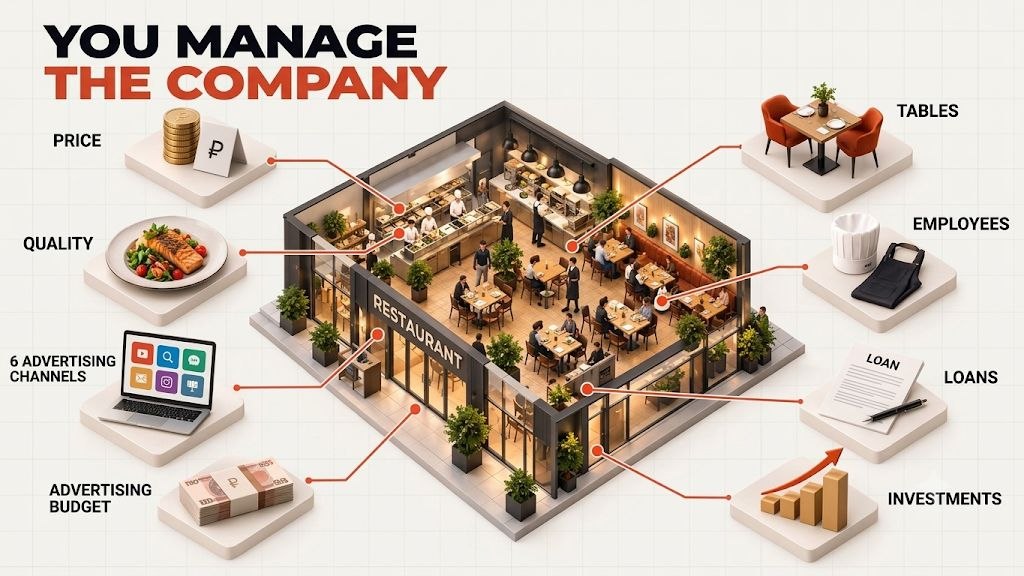
You run a company: price, quality, six advertising channels, advertising budget, tables, staff, loans and investments
PriceQuality 6 advertising channelsAdvertising budget Number of tablesStaff LoansInvestments

No instrument works on its own. A low price without quality brings customers who never come back. Advertising without capacity brings a queue nobody can serve. A loan closes one cash gap and creates another.

THE MAIN THING ABOUT THE GAME

The food court is just a shell

In the game you run a restaurant in a food court. That does not mean the game is about restaurants.

Replace the set lunch with a subscription, window fitting, a haircut, legal services, an English course or a shipment of goods from China — the model does not change by a single step. Limited demand. Competitors fighting for the same people. Price against quality. Advertising that may never pay off. Capacity that runs into money. And a cash gap that arrives before the profit does.

The food court was chosen because anyone can understand its rules in two minutes, with no industry context. After that, your own business begins — just without the risk of losing real money on it.

The market counts by itself: companies make decisions, the model calculates, 10,000 customers are split between restaurants, and a monthly report appears — revenue, costs, profit, cash and market share

The same mechanics fit any business: only the sign above the door changes.

AND WHY NOT JUST ASK AN AI

You are playing against people, not against models

Ask an AI for a strategy and you get a competent, lawful and completely standard answer. The trouble is that on a real market you are not up against a model — you are up against the person at the next table.

It is like chess. A game against an engine and a game against a human being are two different games. The engine looks for the best move. A person digs in, bluffs, cuts prices out of spite, copies you two months too late, or suddenly does something no calculation would ever propose. That is precisely what you cannot prepare for from a textbook.

Which is why the best table to sit at is one where the others are more experienced than you. In a single evening you see moves that appear in no manual, and you learn how people actually behave on a market.

THE MISTAKE THIS GAME EXPOSES

You can build a flawless company. The price is calculated, the quality is honest, the advertising is in the right channels, the room is sized to demand — everything adds up on paper. And you still lose, because the competitor beside you behaved in a way your model never allowed for.

What decides the fate of a business is not how the company is arranged inside, but what happens between you and the next table. No consultant will show you that — human or artificial.

WHY PEOPLE PLAY IT

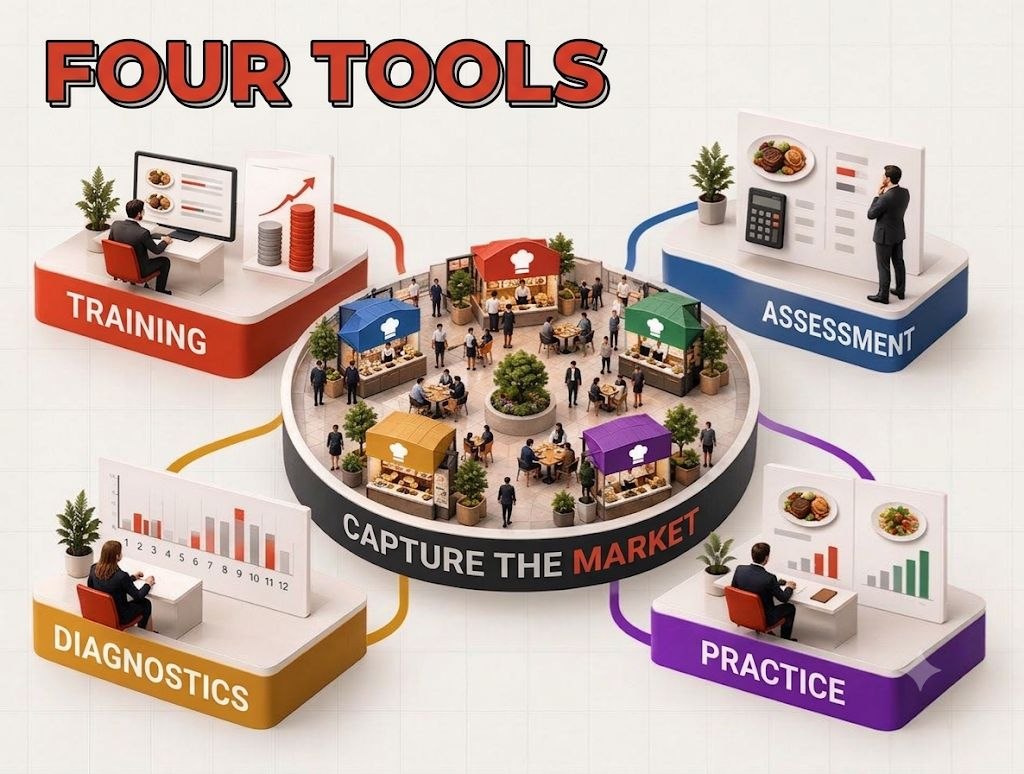
Four instruments in one format

Four uses of the game Capture the Market: training, assessment, diagnostics and practice
TRAINING

Skills are built through action. Not lecture notes on unit economics, but a decision that turned into a loss a month later.

ASSESSMENT

One game shows how a person does the maths, decides on incomplete data and takes a hit. A CV shows none of that.

DIAGNOSTICS

Managerial habits show up in the very first turns. You will see your own strengths and weak spots yourself, without anyone else's grades.

PRACTICE

The game can be repeated: change strategy, try it differently and compare the result on the same model.

What one game reveals about a person

WHO IT FITS

Who we usually see at the table

Entrepreneurs

To test a strategy and managerial habits where a mistake costs only points.

Managers and teams

To see how a team makes decisions under pressure and a hard time limit.

HR and L&D

Assessment and training in one event, with observable behaviour instead of questionnaires.

Those still getting ready

To understand the price of typical mistakes before having to pay it with their own money.

Three leagues

Leagues differ in how long the game runs and who sits at the table. Pick the one that describes you today.

LEAGUE 12 · START

No business yet

$25per team, not per person

You are about to start something and want to learn the price of the usual mistakes before you pay it with your own money.

  • 12 game months in a single session
  • You play against other beginners
  • Decision debrief after the game
LEAGUE 24 · GROWTH

Your business runs

$100per team, not per person

Up to ten employees and up to a million dollars a year. Time to see what your strategy does over a longer distance.

  • 24 game months in a single session
  • You play against working founders
  • Debrief against your real economics
LEAGUE 36 · ELITE

Medium and large business

$3000per team, not per person

A strategy session: test a hypothesis over a long horizon, watch your management team in action and take the decisions apart step by step.

  • 36 game months in a single session
  • You play against medium and large business owners
  • Extended debrief for the owner

The price is for the whole team. A team can be any size: come alone, come as a pair, or bring a department. A single game seats four to twenty teams — the fuller the table, the tighter the market and the more honest the result.

SCHEDULE

Upcoming games

Games run in four streams: Europe, the Americas, Russian and Vietnamese. Times are shown on your own clock — the page reads the timezone from your device.

Turn on JavaScript to see the schedule — or just send a request and a manager will name the nearest dates.

You can join any stream. A stream is the host's language and an hour that suits that region, not a restriction by country. If none of the times work, send a request and tell us when you are free.

THE AUTHOR
Nikolay Vladimirovich Bulenkov

Nikolay Vladimirovich Bulenkov

Creator of team business games and corporate training programmes. More than twenty years in sales, management and business development.

  • 2014

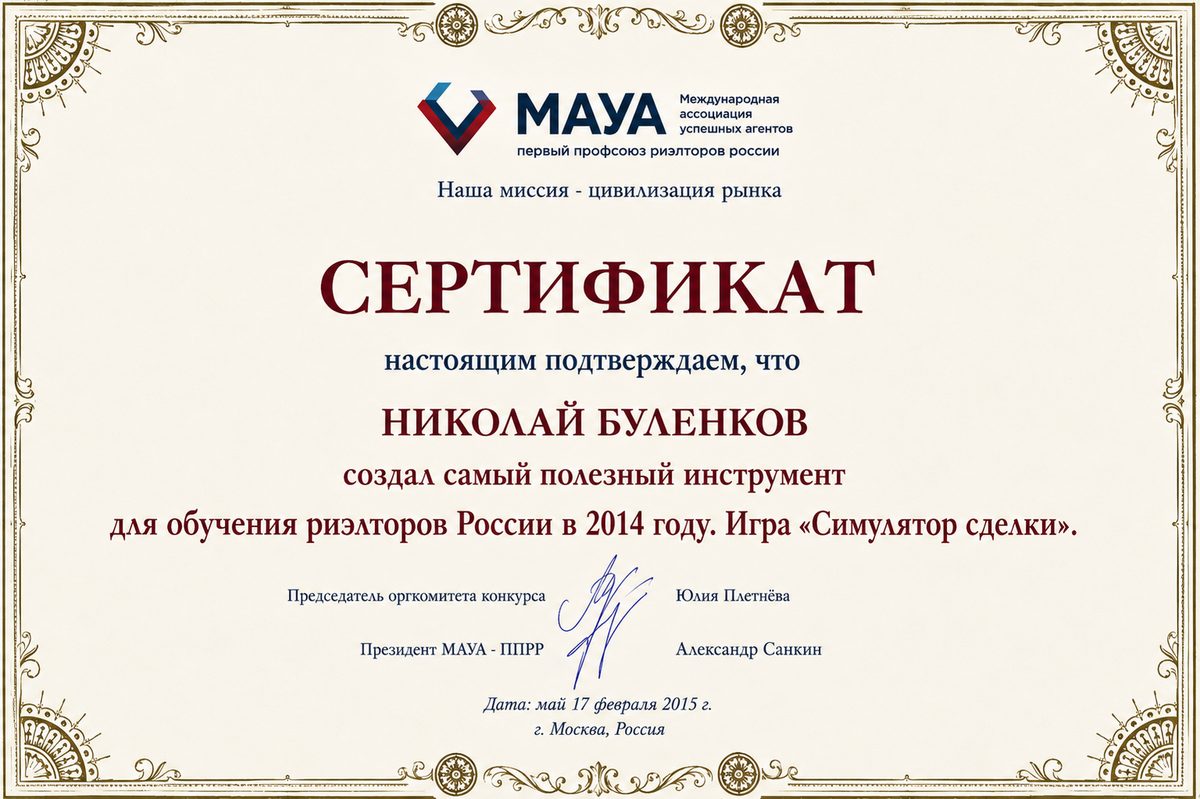
    Created the game “Deal Simulator” — a training tool for real-estate agents. Named the most useful tool for training realtors in Russia in 2014 by MAUA, the country's first realtors' trade union.

    MAUA certificate: Nikolay Bulenkov created the most useful tool for training realtors in Russia in 2014 — the game Deal Simulator Click to open the full certificate
  • 2017—2019

    Sales director at Like Centre (Ayaz Shabutdinov). In the 2019 results the company topped the ranking of online schools for entrepreneurs, ahead of Skolkovo, the EY Business Academy and the PwC academy.

  • 2019—2021

    Head of the training centre of the “33 Slona” project within Mail.ru Group.

  • Practice

    Grew a department's gross revenue from 130 to 900 million ₽. Managed the development of a network of 21 real-estate agencies. Implemented CRM and ERP systems that doubled the effective working time of the managers.

  • Education

    Bauman Moscow State Technical University, radio-electronic systems and devices.

Beyond the games — tracking and consulting

The game shows how you make decisions. Tracking and consulting are work on your actual business: regular reviews of tasks, metrics and next steps.

FREQUENTLY ASKED

The short answers

I want to start a business but have no experience. Where do I start?

With a cheap mistake. In one evening the game walks you through what normally takes a year: you set a price, pour money into advertising, and run into a cash gap. Here the mistake costs points instead of savings. So when the same thing happens to your own money, you have already been through it and know how it ends.

How much does it cost?

Three leagues: $25 per team if you have no business yet; $100 if your business already runs — up to ten employees and up to a million dollars a year; $3000 for a strategy session for medium and large companies. The price always covers the whole team, and a team can be any size.

What is the difference between the leagues?

Two things only: the length of the game and who else is at the table. League 12 is twelve turns among other beginners. League 24 is twenty-four turns among working founders. League 36 is thirty-six turns among owners of medium and large businesses. The market model itself is the same in every league — we do not tune it to your industry.

12, 24, 36 months — how much of my time is that?

The months are game months, not calendar ones: you are not waiting a year, let alone three. The whole game runs in a single session, and one game month is one turn of three to five minutes. What differs between leagues is how many of those turns you get, and how far ahead the consequences of your decisions become visible.

Why play at all, if I can just ask an AI for a strategy?

An AI will hand you a competent, standard strategy — which is exactly what never happens on a real market. There you are up against people: they dig in, bluff, cut prices out of spite and make moves no calculation would allow for. The game gives you what no consultant can — how competitors actually behave, rather than a textbook derivation.

Is it online, or do I have to travel somewhere?

Both work. The mechanics are identical: you make decisions, the model does the maths, everyone sees the result. Offline adds live negotiation at the next table; online lets you assemble a team from different cities.

Do I need to prepare or learn the rules in advance?

No. There is no briefing before the game, and that is deliberate. The mechanics become clear within the first few months, exactly as in business, where nobody hands you a manual before opening day.

How is this different from a business course?

A course explains unit economics to you. Here you set the price yourself, lose customers yourself, and read the report that shows your advertising never paid off. Nobody hands out grades: only the market counts.

I am on my own, without a team. Can I still play?

Yes. A team of one is still a team, and the price is the same. You will be playing against the other participants, not against the host.
YOUR NEXT MOVE

Test the business before you pay for it

Mistakes here cost only points. Everything else is just like life.